📑 THE PROBLEM
A lot of instruments gather dust.
A lot of adults pick up an instrument during some quiet moment in their life. A pandemic, a career change, a slow Sunday. And then a few months go by and the instrument just sits there. The initial excitement wears off, and practice starts to feel like one more chore instead of something fun.
I wanted to design something that made practice feel less like an obligation, and more like something worth coming back to.
I wanted to design something that made practice feel less like an obligation, and more like something worth coming back to.
📝 THE RESEARCH
I thought I knew the problem.
Turns out I didn't.
Before talking to anyone, I'd already started designing the solution in my head. Structured goal tracking, practice journals, a schedule, all the things that sound productive on paper. I assumed adult musicians just needed more discipline.
Five interviews later, that assumption didn't really hold up!
Five interviews later, that assumption didn't really hold up!
I play when the mood strikes. I don't want it to feel like homework.
— Interview participant, age 34
I just want to enjoy it. I'm not performing for anyone. I'm doing this for me.
— Interview participant, age 41
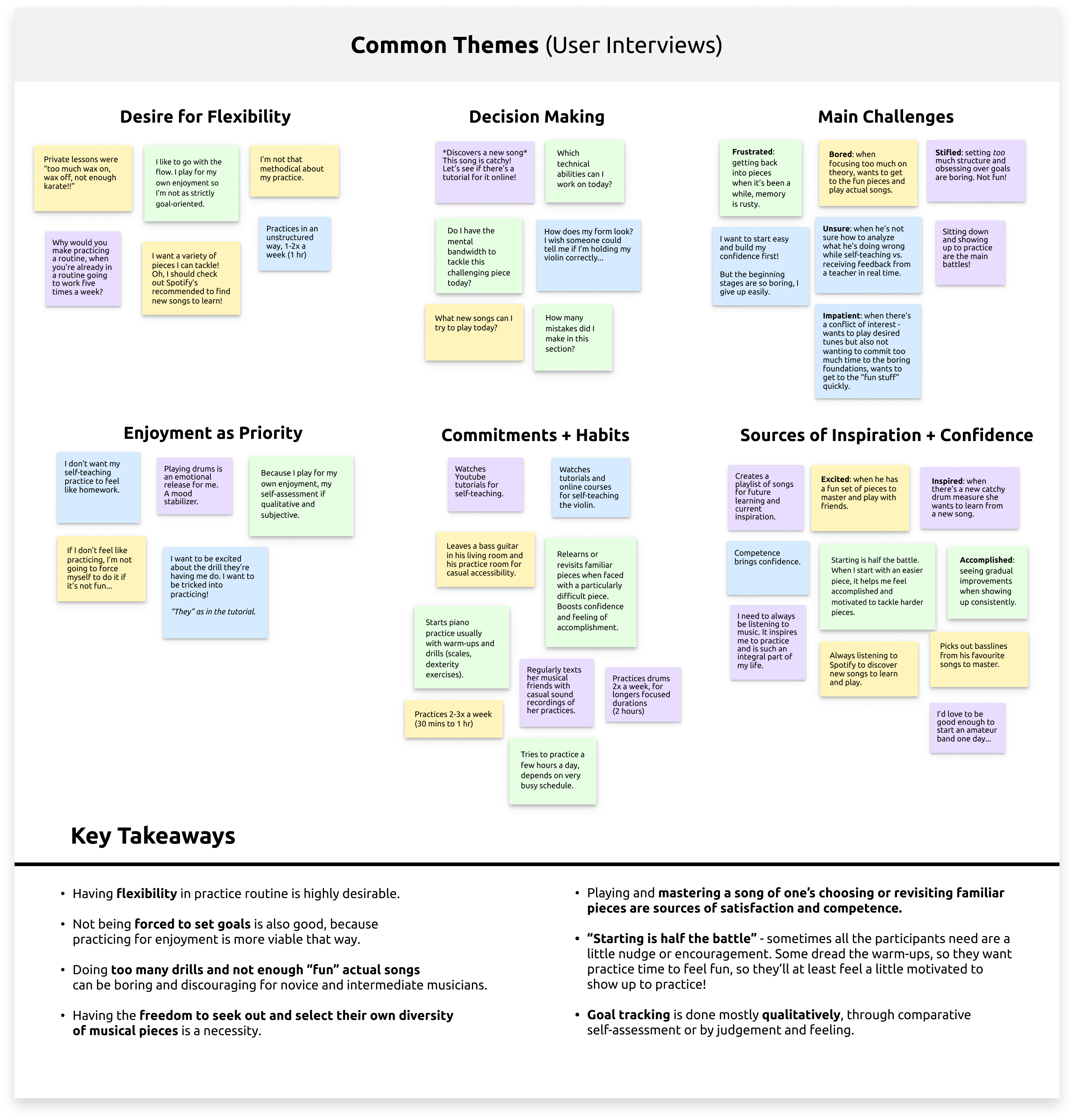
What came through clearly was that these adults weren't trying to become concert pianists. They played because it felt good, not because they wanted another thing to be disciplined about.
What they actually needed was permission to miss a day without feeling guilty about it. Something that invited them back in instead of nagging them to show up.
The motivation was already there. I just needed to design something that didn't get in its way.
What they actually needed was permission to miss a day without feeling guilty about it. Something that invited them back in instead of nagging them to show up.
The motivation was already there. I just needed to design something that didn't get in its way.
💡KEY INSIGHT
"You are not the user" is one of those UX principles everyone learns early on.
This is one of those UX principles everyone learns early, but it really clicked for me on this project. I'd been designing around my own assumptions instead of my participants' actual experiences, and once I let go of that, it changed almost every decision after.
This is one of those UX principles everyone learns early, but it really clicked for me on this project. I'd been designing around my own assumptions instead of my participants' actual experiences, and once I let go of that, it changed almost every decision after.
🎻 THE PIVOT
Out with the tracker. In with the frog.
WHAT I ASSUMED
• Users need structured schedules
• Goal-tracking drives consistency
• Discipline is the missing ingredient
• A habit journal would solve it
WHAT THE RESEARCH SAID
• Flexibility > rigid routine
• Joy and spontaneity drive practice
• Play is already internally motivated
• They wanted fun, not accountability
What I'd assumed going in: that users needed structure and goal-tracking would drive consistency. I thought a habit journal would help close the gap.
What the research actually said: people wanted flexibility over rigid routine. They were already motivated when the music felt joyful and what they were missing wasn't accountability, it was fun.
So the direction shifted toward gamification instead of tracking. Practice gets broken into natural musical chunks, a verse, a chorus, a bridge, and each one becomes a small task within a bigger adventure. Finish a verse, help Fable the frog gather strawberries. Finish a chorus, unlock the next part of the journey.
The goal became making practice feel like playing music again, not like managing another habit tracker.
What the research actually said: people wanted flexibility over rigid routine. They were already motivated when the music felt joyful and what they were missing wasn't accountability, it was fun.
So the direction shifted toward gamification instead of tracking. Practice gets broken into natural musical chunks, a verse, a chorus, a bridge, and each one becomes a small task within a bigger adventure. Finish a verse, help Fable the frog gather strawberries. Finish a chorus, unlock the next part of the journey.
The goal became making practice feel like playing music again, not like managing another habit tracker.
💡 DEFINING THE USER
Meet Gabriela.
Using what I learned from research, I built a persona to represent the people Fable is actually for. Gabriela, or Gabby, taught herself music and genuinely loves it, but she hits a motivational wall sometimes. She plays for joy, not performance, and the last thing she wants is something that feels like homework.

GOAL
Practice consistently without it feeling like a chore
FRUSTRATION
Loses motivation when practice feels repetitive or joyless
MOTIVATION
Plays for pure enjoyment. Flexible, spontaneous, mood-driven
📝 IDEATION
Pencil first, pixels later.
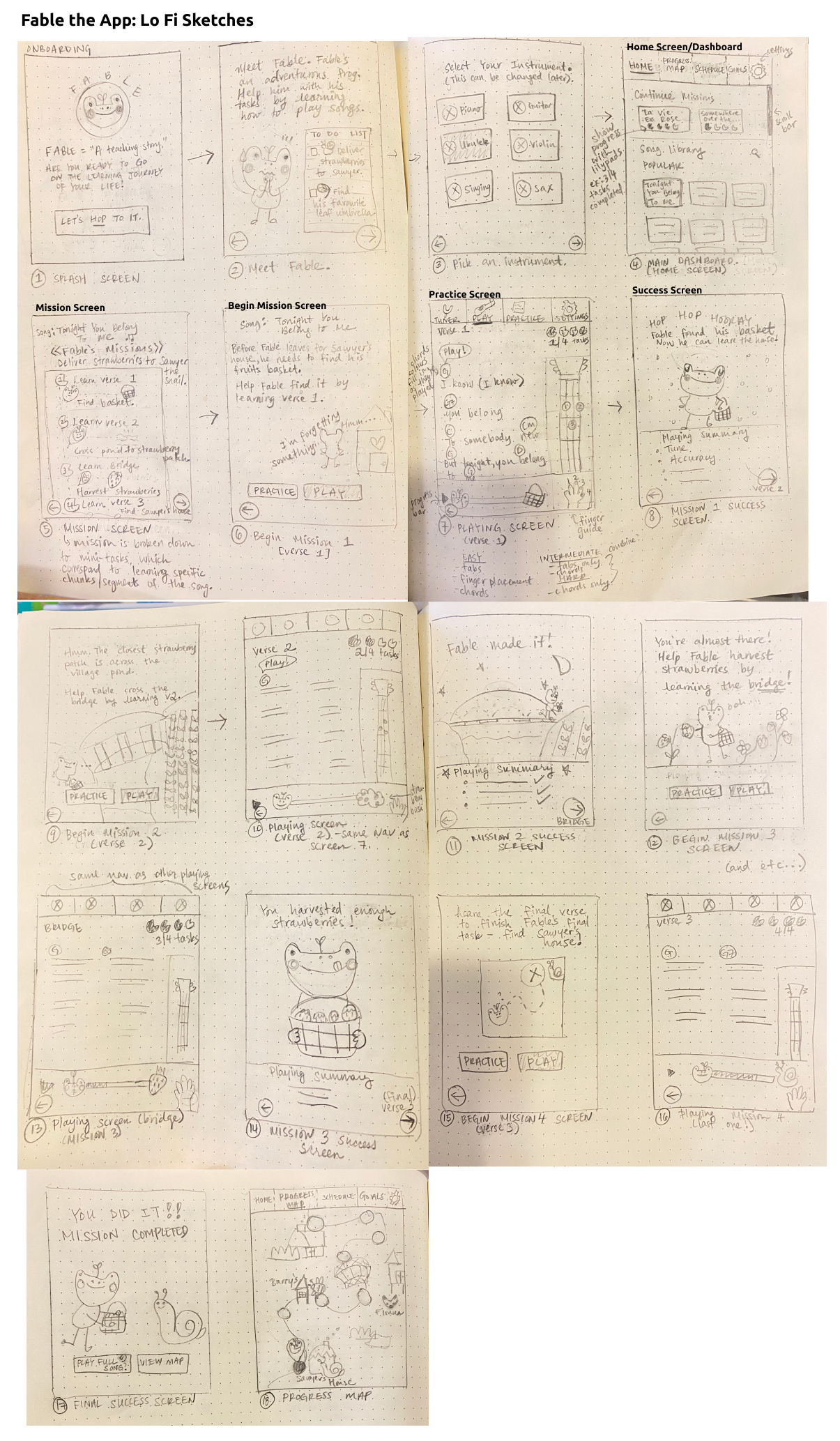
Before touching Figma, I sketched out the Fable narrative as a storyboard of Gabby and Fable’s journey. The doodles were intentionally rough. I just wanted to test the concept, not focus on polish yet.
🎨 BRANDING + STYLE
Storybook energy, not childish
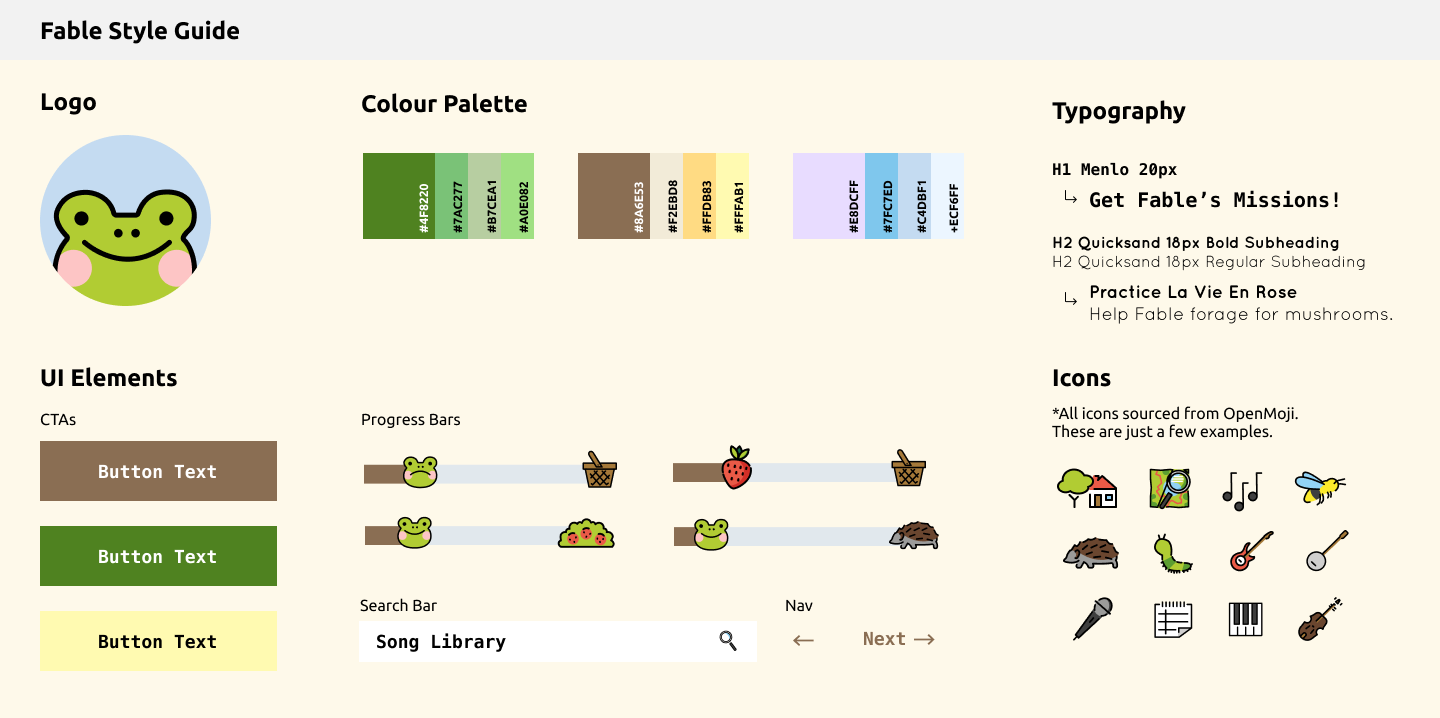
I wanted Fable to feel playful and whimsical without feeling childish. Solid color blocks, playful outlines, and Menlo as the display font give it a retro game/typewriter feel, which matched the storytelling tone of the app.
🐸 THE PROTOTYPE
Let's hop to it!
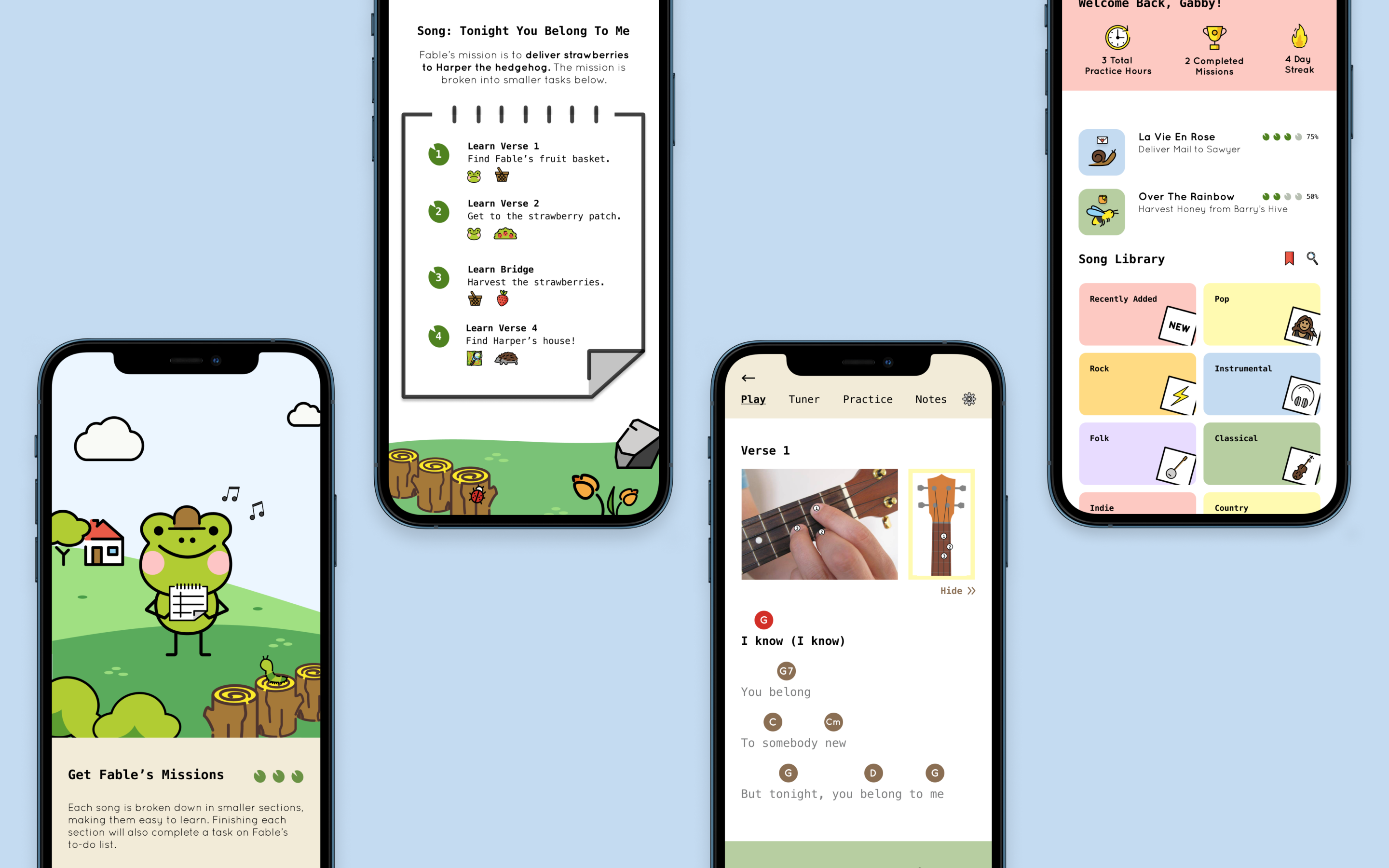
The experience is structured around onboarding, song browsing, mission starts, session completion, and a level map for progress.
Instead of feeling like a dashboard, each screen reads as a chapter in a story or larger narrative.
Instead of feeling like a dashboard, each screen reads as a chapter in a story or larger narrative.
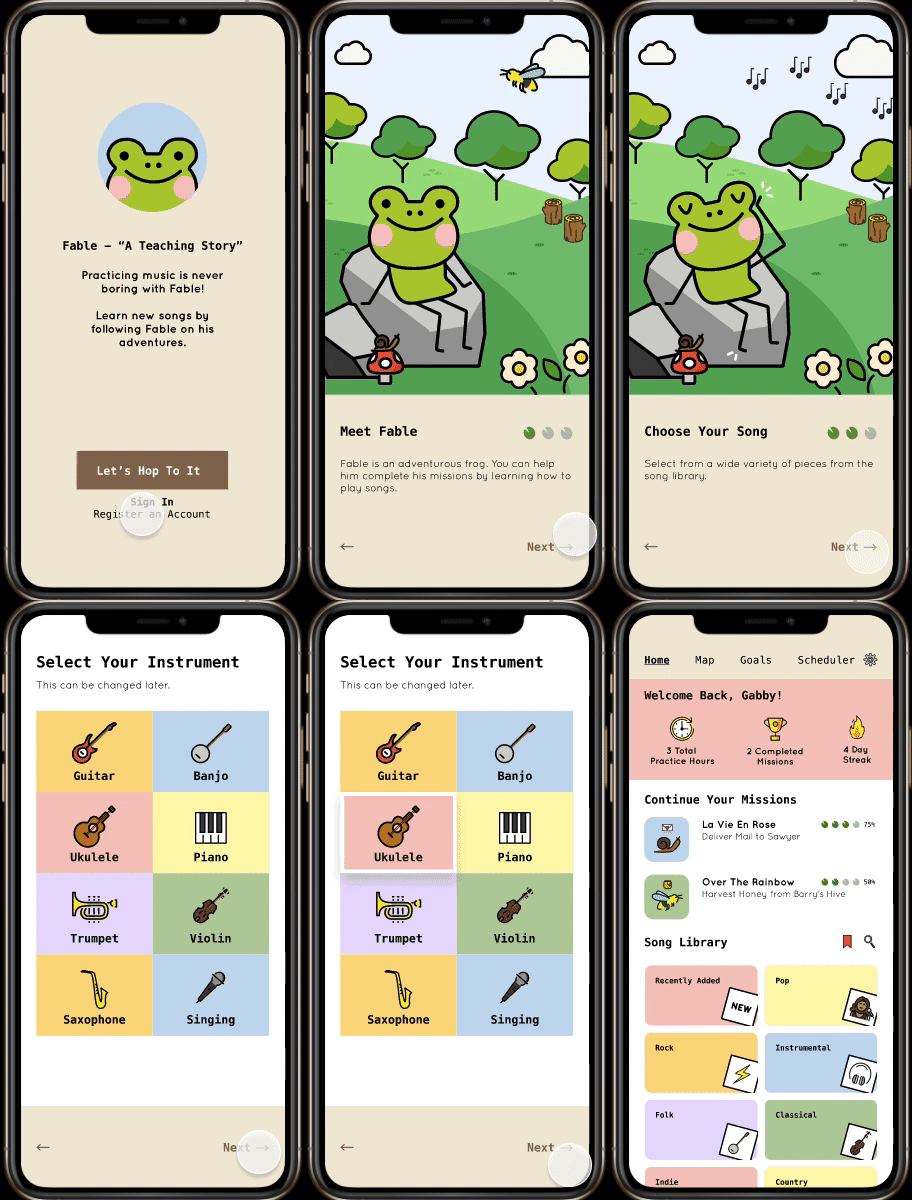
Onboarding: Meeting Fable
Gabby is introduced to Fable and selects her instrument. This sets up how missions will map to practice going forward.
Gabby is introduced to Fable and selects her instrument. This sets up how missions will map to practice going forward.
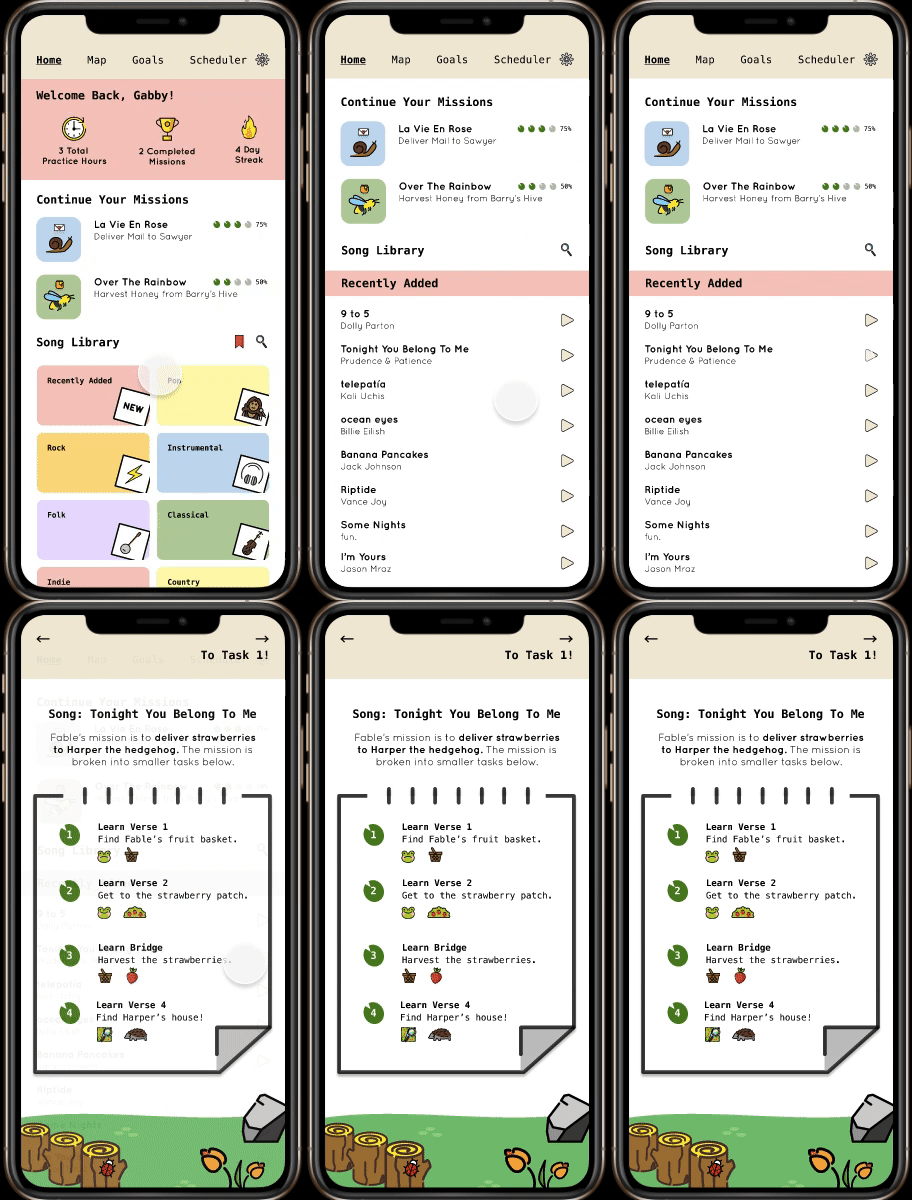
Selecting Songs
Returning users see progress, streaks, and available songs to resume. Songs are grouped by genre for easier browsing.
Returning users see progress, streaks, and available songs to resume. Songs are grouped by genre for easier browsing.
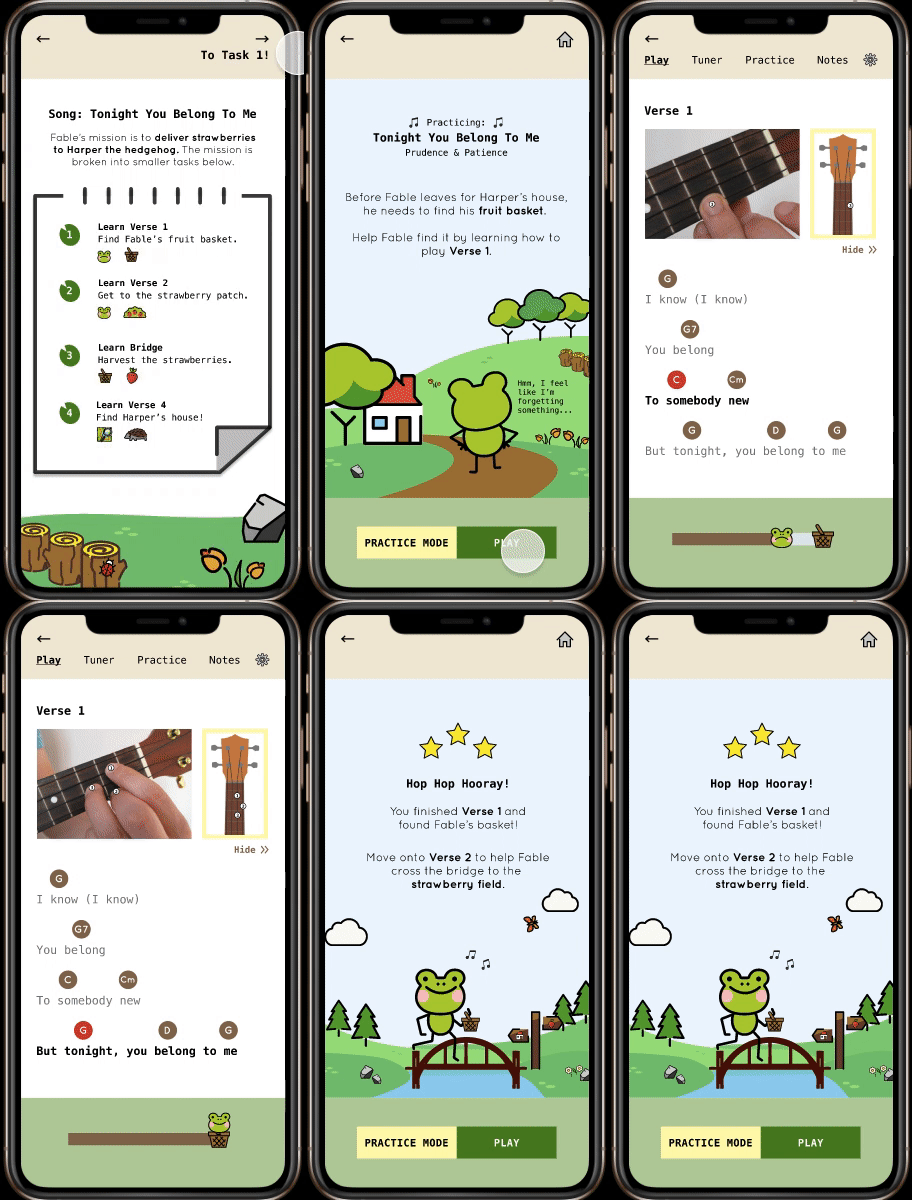
Starting Mission #1
Starting the first verse triggers a mission: help Fable find his fruit basket before heading to the strawberry field.
Starting the first verse triggers a mission: help Fable find his fruit basket before heading to the strawberry field.
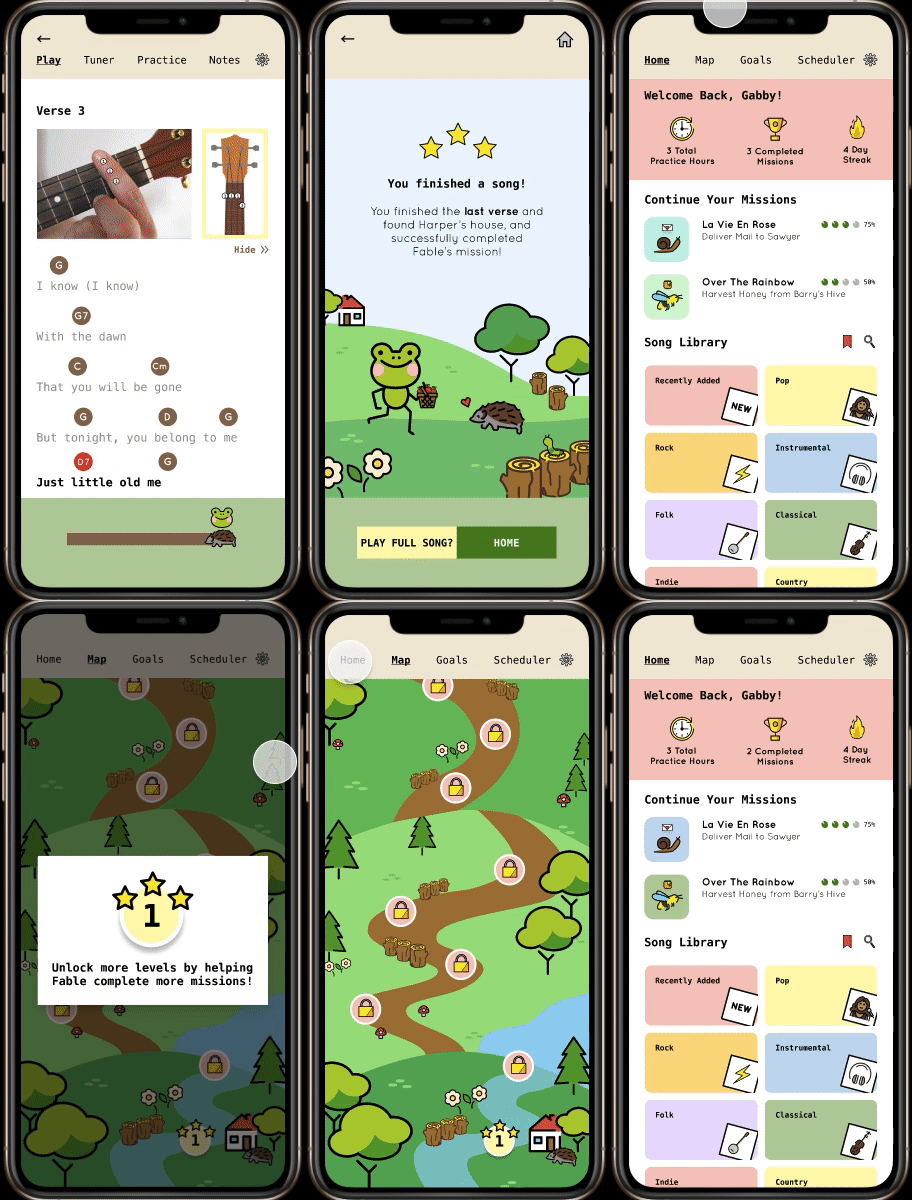
Success: Mission Complete
After completing all four tasks, the song and mission are finished. Gabby returns to the level map to continue progressing.
After completing all four tasks, the song and mission are finished. Gabby returns to the level map to continue progressing.
🧪 USABILITY TESTING
100% task completion. Clear signals for improvement.
I tested the prototype with three participants: two remote via Maze and one in person. All three completed the core flow successfully.
Overall, the experience held up well, but the feedback highlighted a few areas to refine.
Overall, the experience held up well, but the feedback highlighted a few areas to refine.
✅ What worked
Onboarding was straightforward, and the Fable concept clicked quickly. The visual language stayed consistent and helped ground the experience.
🔧 What needed work
The level map wasn’t immediately legible, a few tap targets caused hesitation, and songs needed better organization. Returning users also needed a more tailored starting point.
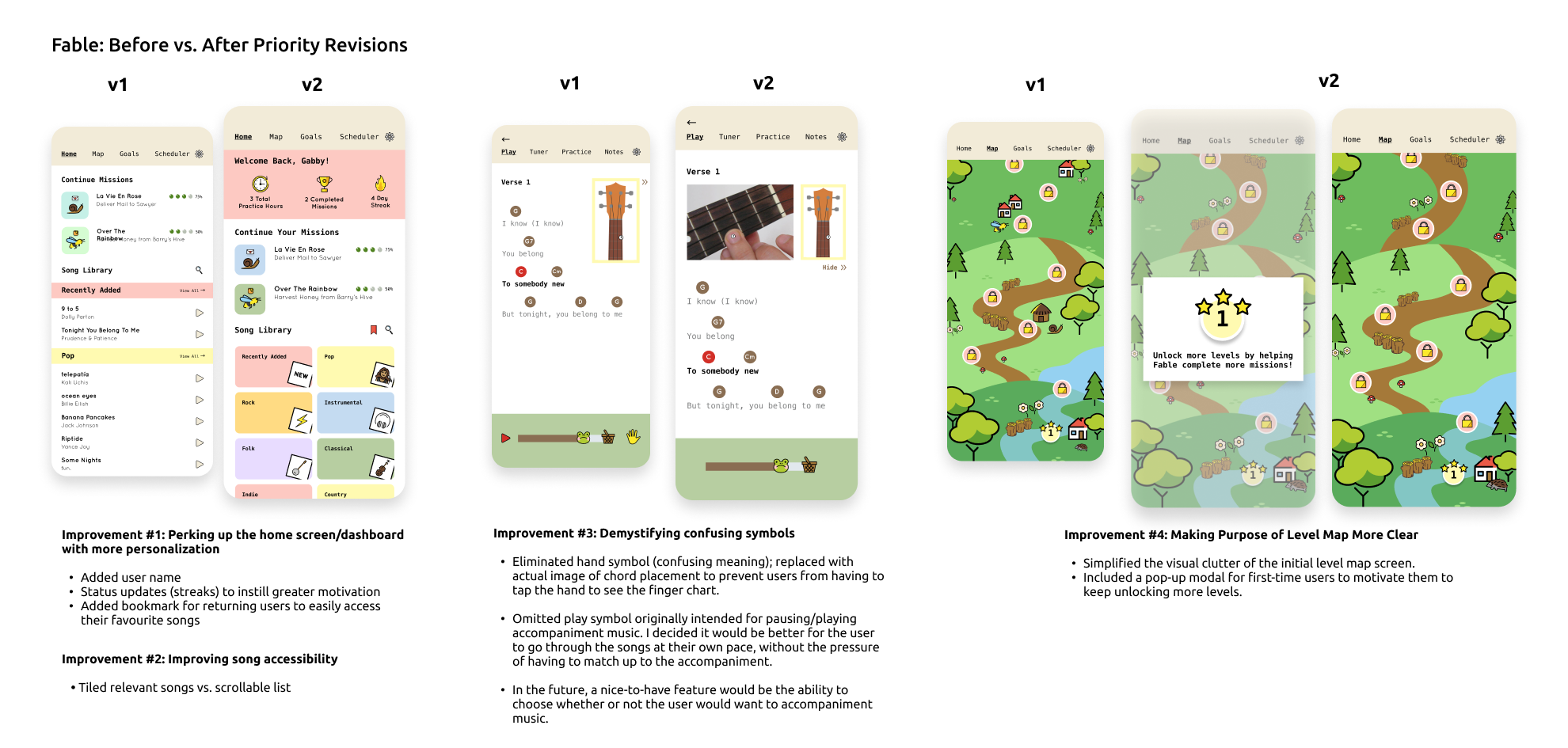
The research doesn't just inform design. Sometimes it reshapes it.
LESSON 01
You are not the user. Really.
I went into research with a solution already forming in my head. The pivot wasn’t a setback; it was the research doing exactly what it’s supposed to do.
LESSON 02
Delight is a design decision.
Joy isn’t decoration. For a product built around motivation, “fun” wasn’t optional! It was part of the core UX.
LESSON 03
Narrative structure carries users.
Breaking the flow into a story helped turn small actions into meaningful steps. The structure aligns with how people naturally understand progress.
LESSON 04
Test early, even when it's rough.
Getting a mid-fi prototype in front of users early surfaced issues that shaped every later decision.
The biggest lesson for me was being willing to change direction when research pointed somewhere clearer.
I had gone into ideation with a solution already forming, and the pivot toward a more playful, gamified approach made the product significantly stronger.
Thank you for reading!
I had gone into ideation with a solution already forming, and the pivot toward a more playful, gamified approach made the product significantly stronger.
Thank you for reading!